
Choose a loading end
Show how staff will insert the product and which end shoppers will open.
Build a folding carton around product loading, closure direction and shelf display.
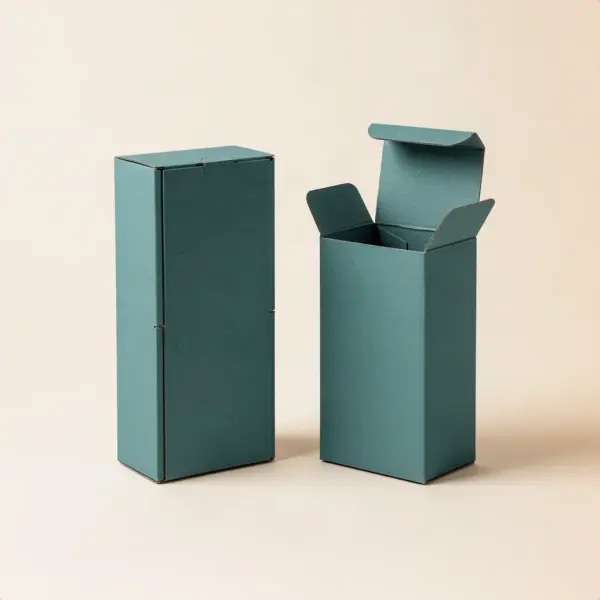
Show how staff will insert the product and which end shoppers will open.
Proof a folded sample and keep fine type and barcodes clear of scores and seams.
Review tuck orientation while the carton is filled. Keep essential artwork on consistently visible panels.
A tuck-end carton closes with a flap that inserts behind a panel. Decide which end staff will load and which end the customer will open. Show the preferred front face so the closure and main seam can be checked together in the assembled carton.
Measure the filled item at its widest and tallest points. If the product has a cap, irregular corner or insert, note the clearance it needs when entering the carton. Try closing the sample at both ends and see whether a packed product pushes on the tuck flaps.
Mark the relationship between the front panel, closure and side information panels. Keep small print or a barcode away from scores and seams. Review the carton on a shelf and again when opened to confirm that the artwork orientation makes sense both ways.
Ask a packer to assemble and close a few cartons in sequence. Note whether the flap catches on the insert or opens during ordinary handling. Give the supplier the filled weight, internal dimensions and proof notes so the board and closure can be quoted together.
Use the pack orientation and loading workflow to decide how staff fill it and customers open it.